
Capabilities
Forty-odd years of one problem: getting light to do what the electronics says.
Conoptics was founded in 1981 by former product managers of the Coherent Modulator Division. The products go into research laboratories, universities, disc manufacturers and laser manufacturers, and the line has kept widening ever since.
Where the line reaches
- Optical bandwidth
- 192nm to 2000nm
- Modulation bandwidth
- DC out to 800MHz
- Phase modulation
- High frequency line to 500MHz
- Pulse selection
- Single pulse to 30MHz, sources to 100MHz
- Minimum pulse width
- 18ns measured at zero, no upper limit
- Transmission
- Greater than 85%
What we build
Which, broken down, is four families that share one bench.
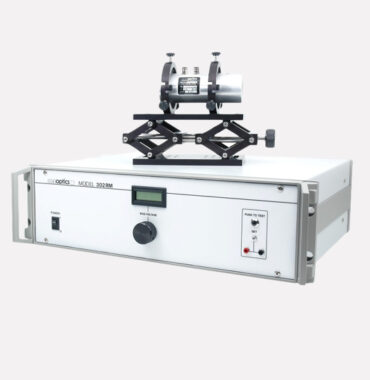
Modulation systems
- All modulators in the line are transverse field type: the electric field is applied across the beam rather than along it.
- Multiphoton microscopy at standard wavelengths, and a dispersion compensated system built for the Insight DS+ and Chameleon Discovery lasers over 680nm to 1300nm.
- Ultraviolet multiphoton from 325nm to 525nm.
- Shutter systems configured for single molecule fluorescence polarization, time-domain thermoreflectance and high-power laser machining.
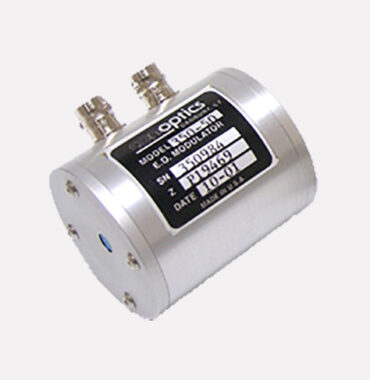
Phase modulation
- A high frequency phase line running to 500MHz.
- Systems built specifically around the Pound Drever-Hall technique for laser frequency locking.
- Any phase modulator can be run as an amplitude modulator given the right polarizer in front of it.
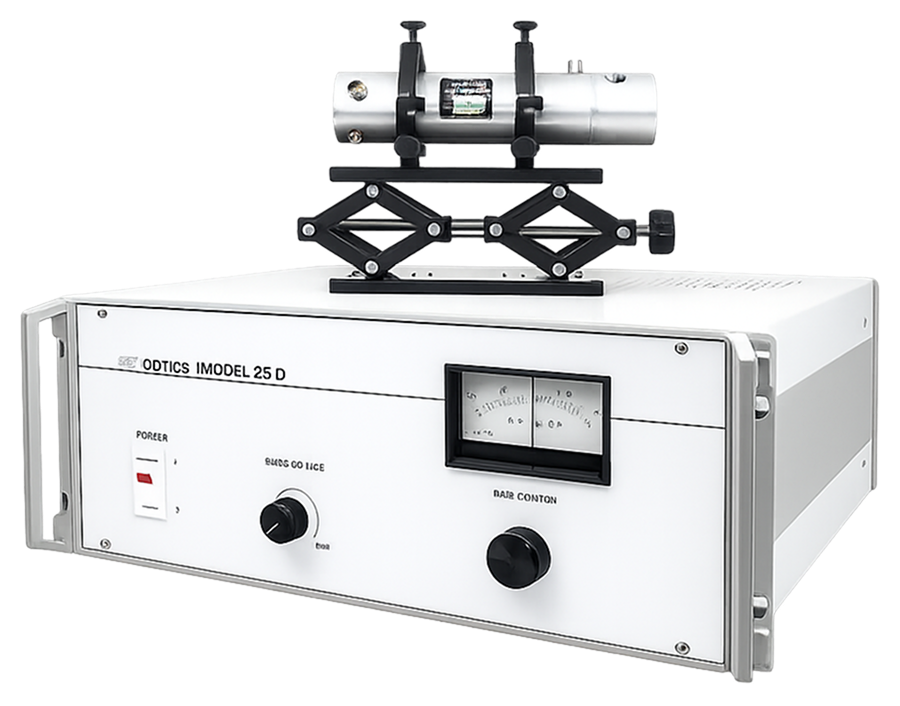
Deflection systems
- A quadrupole electric field inside the electro-optic material bends the beam, so the angle is set electrically with no moving parts.
- Model 412 two-axis system for optical trapping, supplied with two deflectors and a dual linear amplifier.
- Model 320 electro-optic nutator, which scans a linearly polarized collimated beam across the clear aperture of a focusing lens at 1550nm.
Accessories
- Input polarizers, because extinction ratio and transmission both depend on the beam and its polarization entering the Pockels cell correctly.
- The Beam Block assembly terminates the rejected component of the polarizer inside the housing, so no external beam dump is needed and the setup is safer.
- Model 201 attenuator and power splitter, which splits the output of a Ti:Sapphire into two beams with independent power control.
- Mounts and lab jacks for modulators and deflectors.
Milestones
And each of those families started as somebody's problem.
Nothing in the list below was a product plan. Each one was a laboratory or a manufacturer arriving with a wavelength and a timing requirement nothing on the market covered.
Bring us yours- Designed the first DC to 100MHz air-cooled modulation system
- Developed e-o modulators for the colour-separation systems used in laser scanners
- Built the modulation systems for video-disc mastering, including noise eaters for laser noise and exposure control, high speed modulation for content and a multi-function deflector for code tracking
- Developed modulators for use in the deep UV at 257nm
- Developed modulators and high speed drivers for pulse selection systems and regen switches
- Developed optical isolators covering the visible and near infrared
- Worked jointly with Cornell University's Webb Group on a low dispersion modulator for multiphoton microscopy
- Designed miniature optical isolators for 3-D measuring systems
- Developed a high speed, high extinction ratio modulation system for the semiconductor industry
Request a quotation
So the fastest route is to describe the beam you have.
Wavelength, repetition rate, beam diameter and the job. An applications engineer answers with a model number and a lead time. Standard systems ship in 30 to 60 days.
Outside the United States, there are 19 global representatives. Call (203) 743-3349 and we will point you at the nearest one.
Made in Danbury, shipped to nineteen countries.
Everything is built in the works at 19 Eagle Road, Danbury. If a standard configuration does not fit your setup, that is the normal starting point for a conversation here, not the end of one.