
Danbury, Connecticut · electro-optic since 1981
Put a laser beam under electrical control, anywhere from 192nm to 2000nm.
Conoptics makes the modulators, deflectors, pulse pickers, optical isolators and drive electronics that sit between a laser and an experiment. Founded by former product managers of the Coherent Modulator Division, still building in Danbury, shipping in 30 to 60 days.
Domestic orders (800) 748-3349 · 19 global representatives · Made in the USA
The line, at its limits
- Optical bandwidth
- 192nm to 2000nm
- Modulation bandwidth
- to 800MHz
- Phase modulation
- to 500MHz
- Min. pulse width
- 18ns
- Transmission
- over 85%
- Built in
- Danbury, CT, USA
Published figures for the product line. Every system is configured to the source, so the numbers on your quotation are the numbers for your laser.
The product line
Control turns out to be four different jobs.
Gate the beam, steer the beam, pick single pulses out of it, or clean up what is already there. Conoptics builds all four, and they are designed to work together, because most laboratories need more than one of them on the same table.
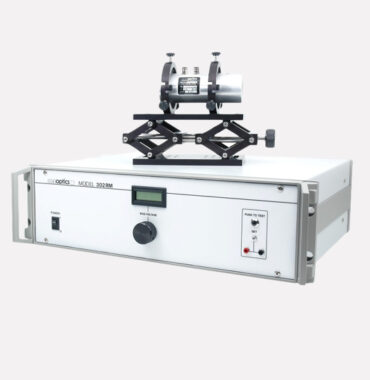
Modulation systems
Transverse-field electro-optic modulators with the drive electronics behind them. The high-frequency phase line runs to 500MHz. Configured against the source rather than sold off a shelf.
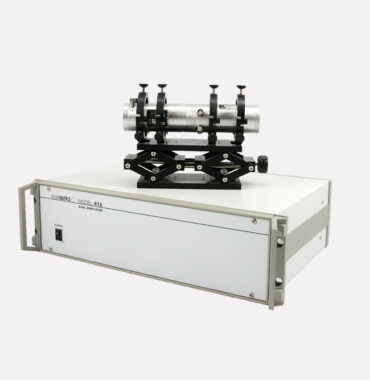
Deflection systems
A quadrupole electric field inside the electro-optic material steers the beam instead of gating it. The Model 412 two-axis system pairs two deflectors with a dual linear amplifier for optical trapping.
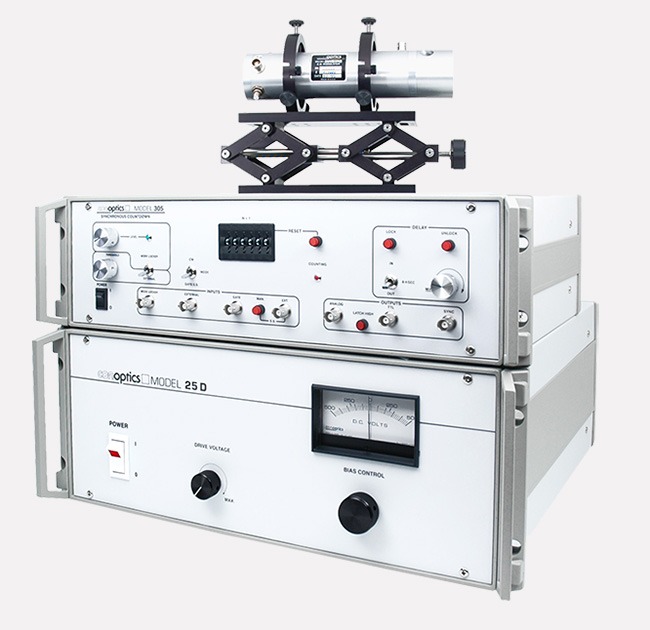
Pulse selection
Pick single pulses out of a mode-locked train. Ti:Sapphire, YAG, YLF and OPO sources from 350nm to 1600nm, interfacing with lasers up to 100MHz, selecting down to one pulse.
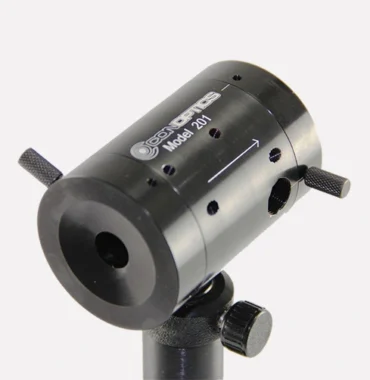
Accessories
Input polarizers that hold the extinction ratio, the integrated Beam Block that terminates the rejected polarization without an external dump, the Model 201 attenuator and power splitter, and mounts that survive alignment.
Selection guide
And which of the four you need is decided by the laser you already own.
Find your source in the left column. The crystal changes with wavelength: KD*P in the visible and near infrared, LTA further out. This is the same table our applications people work from on the phone, so you can arrive at the call already knowing the model number.
| Laser source | Wavelength | Modulator | Crystal |
|---|---|---|---|
| Ti:Sapphire | 350nm to 500nm | Model 350-105 | KD*P series |
| Ti:Sapphire | 700nm to 1064nm | Model 350-160 | KD*P series |
| YAG | 1064nm | Model 360-80 | LTA |
| YLF | 1300nm | Model 360-120 | LTA |
| OPO | 1000nm to 1600nm | Model 360-120 | LTA |
Rep. rate
Single pulse up to 30MHz for mode-locked lasers
Interfaces with
Pulsed sources up to 100MHz, 350nm to 1600nm
Spatial dispersion
None. Centre in, centre out, no angular change
Drive electronics
The crystal is the easy half. The other half is the rack.
A Pockels cell is only as good as the thing switching it. Conoptics builds the amplifiers and the countdown electronics too, so the timing budget is one vendor's problem rather than three. Here is the Model 305 Synchronous Countdown System, published in full, exactly as it reads on the data sheet.
Reference traces were taken with a Mira 900 Ti:Sapphire at 80MHz, a Conoptics Model 25D driver, the Model 305 countdown system and a Model 350-160 modulator.
Model 305 · Synchronous Countdown System
- Mode locker input
- 10MHz min, 70MHz max
- External input
- 10Hz min, 140MHz max
- Countdown range
- f(clock)/2 min to f(clock)/10⁶ max
- Input to output jitter
- Under 100ps, at any count
- Variable delay
- 0 to 8ns, 7 bit digital delay line, 62ps resolution
- Input power
- 85 to 250VAC, 47 to 63Hz, 50W
- Chassis
- 133 H x 430 W x 343 D mm, rack mountable, 6.8kg
Applications
Nobody ever wanted a modulator. They wanted the measurement.
Conoptics worked jointly with Cornell University's Webb Group to develop a low dispersion modulator for multiphoton microscopy, and designed the first DC to 100MHz air-cooled modulation system. The line has since gone into deep UV at 257nm, disc mastering, semiconductor work and optical trapping.
- Intensity and phase modulation
- Pulse selection for mode-locked lasers
- Optical tweezers
- Laser amplitude stabilization
- Multiphoton microscopy, 680nm to 1300nm
- UV multiphoton, 325nm to 525nm
- Pound Drever-Hall locking
- Time-domain thermoreflectance
- Single molecule fluorescence polarization
- High-power laser machining
Request a quotation
Which means the quote starts with your setup, not ours.
Six fields. An applications engineer reads it, works out whether a standard model fits or whether this is a custom build, and comes back with a model number and a lead time rather than a brochure.
- Support
- support@conoptics.com
- Works
- 19 Eagle Road
Danbury, CT 06810
So tell us the laser, and we will tell you the part.
Wavelength, repetition rate, beam diameter and what you are trying to do with it. That is enough for a quotation. If a standard model does not fit, we build the configuration that does, which is most of what we have been doing since 1981.
- 1981
- Founded in Danbury
- 19
- Global representatives
- 30 to 60
- Days to delivery
- 192 to 2000
- Nanometres covered
Before you call
And these are the five questions the phone starts with.
How do I choose a modulator?
Start with the laser, not the catalogue. The wavelength decides the crystal, the beam diameter decides the aperture, and whether you are gating or phase modulating decides the drive electronics. Tell us the source and the job and we will name the model.
What wavelengths does the line cover?
The product line covers the optical bandwidth from 192nm out to 2000nm, and modulation bandwidth out to 800MHz. That includes the deep UV at 257nm, which we developed modulators for, and the ultraviolet multiphoton range from 325nm to 525nm.
How short a pulse can the pulse selection system pass?
Minimum pulse width is 18ns measured at zero, with no limit on the upper end. Selection runs from a single pulse up to 30MHz for mode-locked lasers, and the system interfaces with sources up to 100MHz across 350nm to 1600nm.
What does the extinction ratio depend on?
Alignment, mostly. Extinction ratio and transmission both depend on the beam and its polarization entering the Pockels cell correctly, which is why the input polarizer is a real part of the system rather than an afterthought. Transmission through the pulse selection systems is greater than 85%.
How long is delivery?
30 to 60 days on the standard line, with custom configurations quoted separately. Domestic orders go through (800) 748-3349, international through (203) 743-3349.
Not covered here? Send the details of your setup and an applications engineer answers it.